
Finding fish in the winter is often a puzzle, and honestly, it can feel a bit discouraging at first. In summer, you can follow surface activity, weed lines, or even gut instinct. Winter strips most of that away. Everything looks the same from the top, especially once ice forms. That’s where a basic understanding of limnology, the study of inland waters, quietly becomes one of your most valuable tools.
The real key is thermal stratification. It sounds technical, but the idea itself is fairly simple. Water separates into layers based on temperature, and fish respond to those layers because temperature directly affects their survival and energy use. In winter, those layers matter even more, and fish tend to gather in very specific comfort zones. Miss those zones, and it can feel like the lake is completely empty.
Before getting into the practical steps, it helps to understand what’s actually happening beneath the surface.
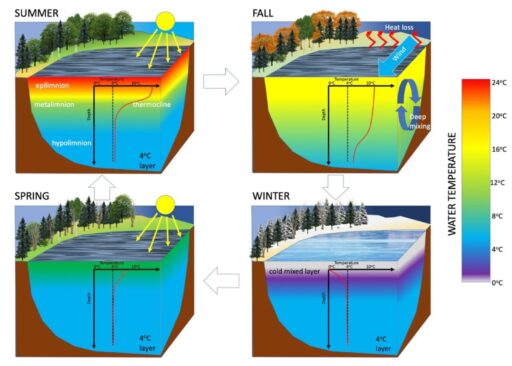
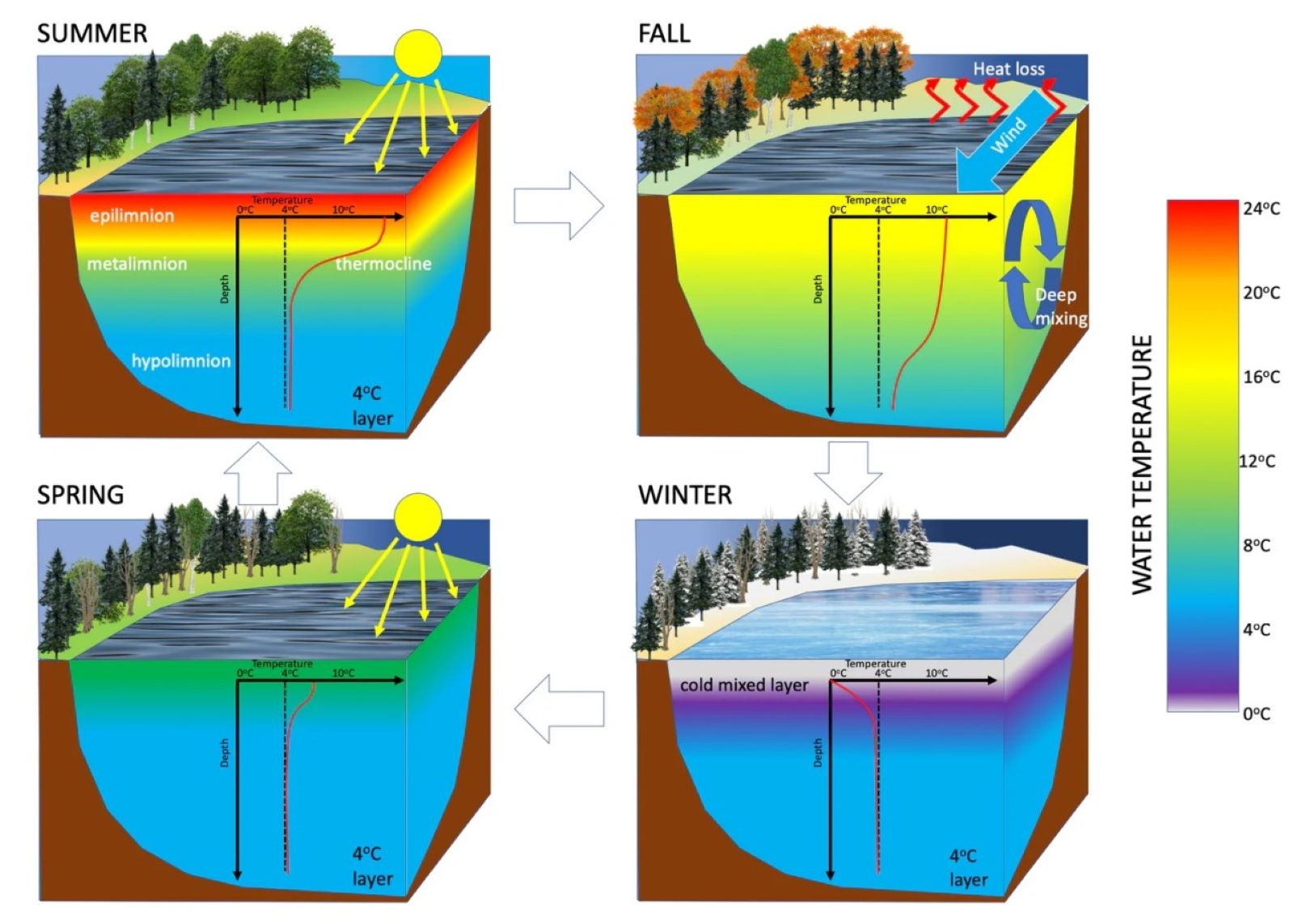
Thermal stratification refers to the way a lake divides into layers of different temperatures. During winter, this becomes what’s known as inverse stratification, where the coldest water sits on top and warmer water settles below.
The thermocline is the transition area between temperature layers. In winter it’s less sharp than in summer, but it still influences where fish hold.
Dissolved oxygen is critical. Fish cannot survive in water that lacks oxygen, even if the temperature is ideal. This one factor overrides almost everything else.
Water density ties it all together. Water is most dense at 39°F (4°C). That small scientific detail is the entire reason lakes don’t freeze solid and why fish can survive beneath the ice.
Once you have those concepts in mind, the patterns start to make more sense.
Step 1: Identify the Inverse Stratification Phase
In summer, warm water floats and cold water sinks. Winter flips that logic entirely.
As air temperatures drop, the surface water cools first. When that surface water reaches 39°F, it becomes dense enough to sink. This heavier water slides downward, displacing slightly warmer water below it. The remaining surface water keeps cooling until it reaches 32°F and freezes.
What’s left is a lake where the coldest water is locked at the top as ice, and the warmest water, relatively speaking, rests at the bottom. That bottom layer stabilizes right around 39°F, and this is where fish want to be. Not because it’s warm in a human sense, but because it’s stable and costs them the least energy.
Understanding this alone can save hours of random drilling or blind casting.
Step 2: Locate the Benthic Zone
The benthic zone is simply the bottom of the lake. In mid-winter, this area becomes the primary holding zone for many species.
Start by identifying the deepest holes in the lake. A bathymetric or topographical map is invaluable here, and if you fish a lake regularly, it’s worth studying it before you ever step onto the ice.
Bottom composition matters more than many anglers realize. Soft bottoms tend to hold dormant insects and larvae, which in turn attract baitfish. Where bait goes, predators usually follow, even in cold water.
That 39°F difference is everything. When the surface is locked at 32°F and the bottom holds at 39°F, fish will often press themselves close to the lake floor. Even a two-degree change can be significant for a cold-blooded animal trying to conserve energy.
Step 3: Find the Oxygen Squeeze
This is where winter fishing becomes less predictable, and maybe more interesting.
While the bottom holds the warmest water, it doesn’t always hold the best oxygen. As winter progresses, decaying organic matter can deplete oxygen near the lake floor, especially in smaller or nutrient-rich lakes.
Electronics help here. A flasher or sonar can reveal a dead zone near the bottom where fish simply don’t appear. If that’s the case, it doesn’t mean the fish left the area entirely.
Often, they slide slightly higher in the water column. Suspended fish, sitting three to five feet off the bottom, are usually balancing two needs: stable temperature and breathable water.
This narrow band is often the most productive zone in mid to late winter. It’s subtle, and easy to overlook, but once you find it, the pattern tends to repeat.
Step 4: Account for Lake Size and Type
Not all lakes behave the same way in winter, and this is where experience really starts to matter.
Shallow lakes may freeze nearly to the bottom or maintain fairly uniform temperatures. In these systems, oxygen is often the limiting factor. Any remaining green weeds become important because they still produce oxygen, even under ice.
Deep reservoirs tend to show stronger stratification. Fish commonly relate to deep river channels, submerged points, and long basin edges where temperature and oxygen overlap.
Spring-fed lakes are their own category. Springs introduce consistent water temperatures, sometimes close to 50°F. These warmer inflows can concentrate fish in very specific areas, often much shallower than you’d expect for winter.
Adjusting your strategy to the type of lake you’re fishing makes a noticeable difference, even if everything else stays the same.
Step 5: Match Your Presentation to Fish Metabolism
At 39°F, fish are not interested in chasing meals. Their metabolism slows dramatically, and every movement costs energy.
This is where downsizing matters. Small jigs, compact spoons, and subtle profiles tend to outperform larger offerings.
Speed is equally important. Slower movements with longer pauses often trigger strikes when aggressive actions fail. Sometimes it feels almost too slow, but that hesitation is usually what convinces a fish to commit.
Live bait can make the difference. Wax worms, spikes, or small minnows add scent and natural movement that artificial lures often lack in cold water. In heavily stratified winter conditions, that extra realism can be the deciding factor.
Winter fishing isn’t about covering water quickly. It’s about understanding where fish have to be, not where you hope they might be. Thermal stratification narrows the lake down to a few key zones. Once you focus there, the puzzle starts to come together, maybe not instantly, but enough to keep you drilling one more hole and dropping a line again.
FAQ: Winter Thermal Stratification
Q. Does thermal stratification happen in moving rivers?
A. Rarely. Current usually mixes the water, keeping the temperature relatively uniform from top to bottom. In rivers, look for “slack water” or deep holes where the current slows down.
Q. What is “Winterkill”?
A. Winterkill occurs in shallow, snow-covered lakes when oxygen levels drop so low that fish cannot survive. This happens when sunlight can’t reach plants to trigger photosynthesis.
Q. Why is 39°F (4°C) so important?
A. This is the temperature at which water is at its maximum density. If water were densest at freezing, lakes would freeze from the bottom up, killing all aquatic life.
Q. Can I find the thermocline with a standard fish finder?
A. Yes. If you turn up the sensitivity (gain) on your sonar, the thermocline often appears as a faint line or a “clutter” layer where the water density changes.